395 posters, 1 audios, 13 topics, 29 sessions, 1,056 authors, 461 institutions
ePostersLive by SciGen Technologies S.A. All rights reserved.
51st Annual Regional Anesthesiology and Acute Pain Medicine Meeting
April 16 - 18, 2026 | Phoenix, Arizona

2317585
Intraoperative Auricular Acupuncture for Total Hip Arthroplasty Surgery: Experiences From A High-Volume Orthopedic Center
Poster Presenter
Part of Topic
Scientific Abstracts > Regional Anesthesia
Introduction
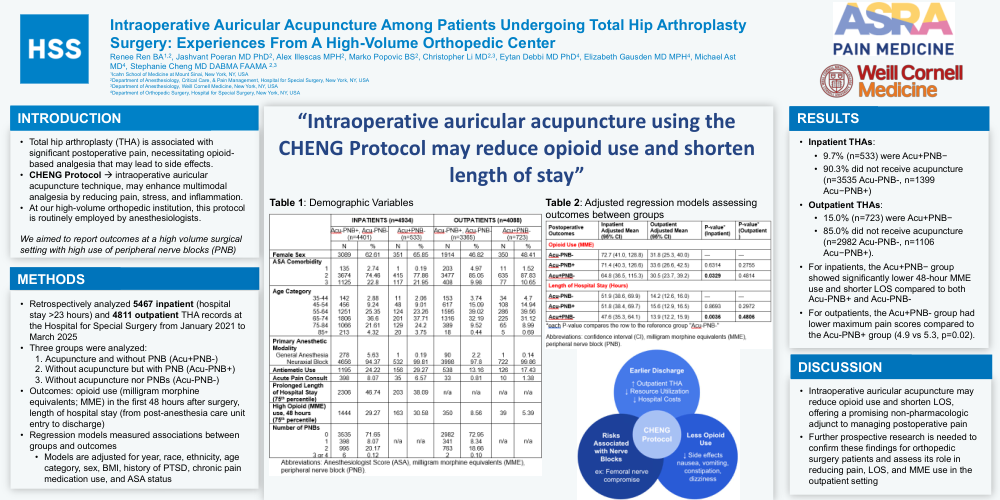
Total hip arthroplasty (THA) is associated with significant postoperative pain, necessitating opioid-based analgesia that may lead to side effects.1 The CHENG Protocol, an intraoperative auricular acupuncture technique, has shown promise in enhancing multimodal analgesia by potentially reducing pain, stress, and inflammation.2 At our high-volume orthopedic institution, this protocol is routinely employed by anesthesiologists. This preliminary report reports various care outcomes in a high throughput optimized surgical setting with high use of peripheral nerve blocks (PNB).
Materials and Methods
After IRB approval (2022-1218), 5467 inpatient and 4811 outpatient THA records at the Hospital for Special Surgery from January 2021 to March 2025 were analyzed. Three groups were identified: with acupuncture and without PNB (Acu+PNB-), without acupuncture but with PNB (Acu-PNB+), and without acupuncture nor PNBs (Acu-PNB-). Inpatient was defined as hospital stay > 23 hours. MME use was calculated for the entire postoperative hospital stay. Outcomes include opioid use (milligram morphine equivalents; MME) in the 48 hours after surgery, length of hospital stay (LOS, from post-anesthesia care unit entry to discharge), and patient-reported pain scores (0 to 10 scale). The “high” category corresponds to the top 75th percentile. Descriptive statistics analyzed demographic data. Regression models measured associations between groups and outcomes. Models adjusted for year, race, ethnicity, age, sex, BMI, PTSD, chronic pain medication use, ASA status. All models include primary surgeon as the random intercept.
Results/Case Report
Among inpatient THAs, 9.7% (n=533) were Acu+PNB− and 90.3% did not receive acupuncture (n=3535 Acu-PNB-, n=1399 Acu−PNB+). In outpatient THAs, 15.0% (n=723) were Acu+PNB− and 85.0% did not receive acupuncture (n=2982 Acu-PNB-, n=1106 Acu−PNB+). Most patients received neuraxial blocks as the primary anesthetic, few received acute pain consults postoperatively, and patients receiving PNBs typically received 2 PNBs (Table 1). In adjusted analyses of inpatients, the Acu+PNB− group showed significantly lower 48-hour MME use (64.8 vs. 72.7, p=0.03) and shorter LOS (47.6 vs 51.9, p=0.004) compared to the Acu-PNB- group (Table 2). For outpatients, the Acu+PNB- group had lower maximum pain scores compared to the Acu-PNB+ group (4.9 vs 5.3, p=0.02).
Discussion
Intraoperative auricular acupuncture using the CHENG protocol may reduce opioid use and shorten LOS, offering a promising non-pharmacologic adjunct to managing postoperative pain especially for THA patients requiring inpatient hospital stays greater than 23 hours. Further prospective research is needed to confirm these findings for orthopedic surgery patients and assess its role in reducing pain, LOS, and potentially MME use in the outpatient setting.
References
1. Tay HP, Wang X, Narayan SW, Penm J, Patanwala AE. Persistent postoperative opioid use after total hip or knee arthroplasty: A systematic review and meta-analysis. Am J Health Syst Pharm. 2022;79(3):147-164. doi:10.1093/ajhp/zxab367
2. Cheng SI, Kelleher DC, DeMeo D, Zhong H, Birch G, Ast MP. Intraoperative Acupuncture as Part of a Multimodal Analgesic Regimen to Reduce Opioid Usage After Total Knee Arthroplasty: A Prospective Cohort Trial. Med Acupunct. 2022;34(1):49-57. doi:10.1089/acu.2021.0072
2. Cheng SI, Kelleher DC, DeMeo D, Zhong H, Birch G, Ast MP. Intraoperative Acupuncture as Part of a Multimodal Analgesic Regimen to Reduce Opioid Usage After Total Knee Arthroplasty: A Prospective Cohort Trial. Med Acupunct. 2022;34(1):49-57. doi:10.1089/acu.2021.0072