395 posters, 1 audios, 13 topics, 29 sessions, 1,056 authors, 461 institutions
ePostersLive by SciGen Technologies S.A. All rights reserved.
51st Annual Regional Anesthesiology and Acute Pain Medicine Meeting
April 16 - 18, 2026 | Phoenix, Arizona

2317361
Expanding the Role of Neuraxial Anesthesia in Pediatric Surgical Patients: Analysis of Trends from a High-Volume Orthopedic Center
Poster Presenter
Part of Topic
Scientific Abstracts > Regional Anesthesia
Introduction
Neuraxial anesthesia (NA) is understudied in pediatric patients, as general anesthesia is standard at most institutions.[1] However, growing evidence supports NA effectiveness in children: it is hemodynamically stable, offers faster recovery and lower costs.[2, 3] At Hospital for Special Surgery, spinals are routinely offered to patients aged < 18.[4] To explore NA trends, we aimed to describe the primary anesthetic modalities for pediatric orthopedic surgeries, describe medication dosage, and describe trends based on age groups.
Materials and Methods
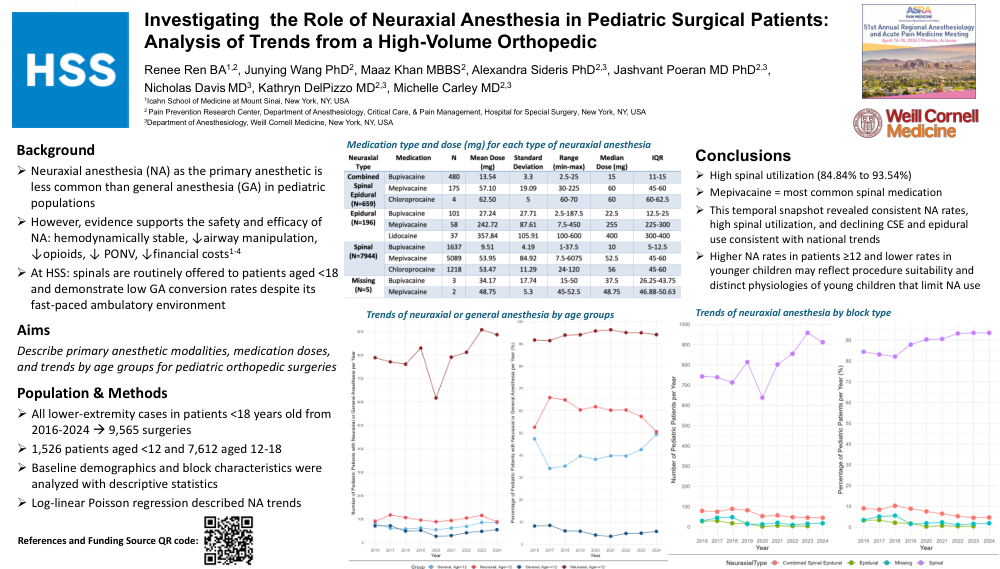
This study was approved by the IRB (#2024-1639). All orthopedic lower-extremity cases in patients < 18 years old from 2016-2024 were analyzed from our specialized orthopedic surgery hospital, yielding a total of 9,565 surgeries. There were 1,526 patients aged < 12 and 7,612 patients aged 12-18. Patient selection for NA was at the discretion of the anesthesiologist and is typically guided by comorbidities, procedure suitability, and patient and surgeon preference. Primary anesthesia type included neuraxial (combined spinal-epidural [CSE], epidural, spinal), general, peripheral nerve block (PNB), or monitored anesthesia care (MAC). Baseline demographics and block characteristics were analyzed with descriptive statistics. Log-linear Poisson regression described NA trends.
Results/Case Report
Overall, 51.4% of patients were female, 96.9% had ASA comorbidity indices of 1 or 2, and 87.4% were scheduled as ambulatory surgeries. Mean±SD age was 14.1±3.9 years, procedure duration was 99.1±67.2 minutes, hospital length of stay was 20.7±30.7 hours. Most cases involved the knee (56.3%), foot/ankle (20.0%), and hip (10.0%).
Primary anesthetic modality stayed consistent from 2016-2024 (Table 1). When analyzed by age groups, up to 91.0% of patients ≥12 years old versus ~10% of patients < 12 received NA (Figure 1). Analysis by NA type from 2016-2024 found high spinal utilization (84.84% to 93.54%), while CSE (8.98% to 4.62%) and epidural use (3.18% to 0.0%) decreased significantly (all p< 0.001). Mepivacaine was the most common medication utilized in spinals (5089/7255 spinals), with a median (IQR) dose of 52.5mg (46-60). Bupivacaine was commonly utilized in CSEs (480/627 CSEs), with median dose of 15.0mg (11-15). Full medication details are listed in Table 2.
Discussion
Our findings provide a temporal snapshot of NA. We found consistent rates of NA, high spinal utilization, and declining use of CSE and epidurals. Variations are small and likely due to year-to-year fluctuations. The wide range of dosing for epidural catheters is likely related to procedure duration. High NA rates in patients ≥12 and lower rates in younger children may reflect suitability of procedure and distinct physiologies of young children that limit applicability of NA.
References
1. Marhofer P, Zadrazil M, Opfermann PL. Pediatric Regional Anesthesia: A Practical Guideline for Daily Clinical Practice. Anesthesiology 143(2): 444, 2025
2. Gupta A, Saha U. Spinal anesthesia in children: A review. J Anaesthesiol Clin Pharmacol 30(1): 10, 2014
3. Eizaga Rebollar R, Garcia Palacios MV, Morales Guerrero J, Torres Morera LM. Pediatric spinal anesthesia at a tertiary care hospital: Eleven years after. Paediatr Anaesth 32(5): 617, 2022
4. Carley M, Sheetz M, Lauzadis J, Zhong H, DelPizzo K. Mepivacaine dosing for spinal anesthesia in pediatric orthopedic surgery: a retrospective chart review. Reg Anesth Pain Med 50(3): 264, 2025