395 posters, 1 audios, 13 topics, 29 sessions, 1,056 authors, 461 institutions
ePostersLive by SciGen Technologies S.A. All rights reserved.
51st Annual Regional Anesthesiology and Acute Pain Medicine Meeting
April 16 - 18, 2026 | Phoenix, Arizona

2316768
An Initial Evaluation of Body Protective Compound 157 (BPC-157) a peptide, as treatment for Musculoskeletal pain
Poster Presenter
Part of Topic
Scientific Abstracts > Chronic Pain
Title: An Initial Evaluation of Body Protective Compound 157 (BPC-157) a peptide, as treatment for Musculoskeletal pain
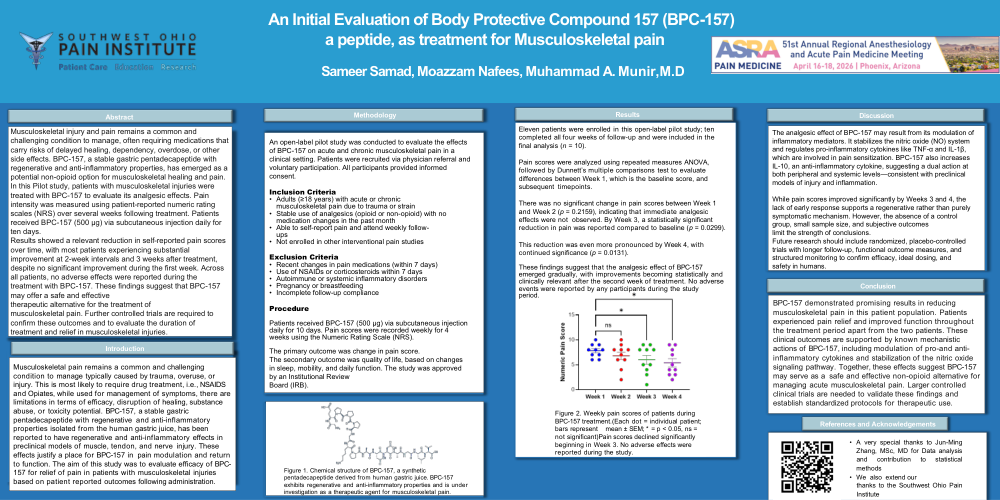
Musculoskeletal injury and pain remains a common and challenging condition to manage, often requiring medications that carry risks of delayed healing, dependency, overdose, or other side effects. BPC-157, a stable gastric pentadecapeptide with regenerative and anti-inflammatory properties, has emerged as a potential non-opioid option for musculoskeletal healing and pain. In this Pilot study, patients with musculoskeletal injuries were treated with BPC-157 to evaluate its analgesic effects. Pain intensity was measured using patient-reported numeric rating scales (NRS) over several weeks following treatment. Patients received BPC-157 (500 µg) via subcutaneous injection daily for ten days. Results showed a relevant reduction in self-reported pain scores over time, with most patients experiencing substantial improvement at 2 week intervals and 3 weeks after treatment, despite no significant improvement during the first week. Across all patients, no adverse effects were reported during the treatment with BPC-157. These findings suggest that BPC-157 may offer a safe and effective therapeutic alternative for the treatment of musculoskeletal pain. Further controlled trials are required to confirm these outcomes and to evaluate the duration of treatment and relief in musculoskeletal injuries.
Introduction
Musculoskeletal pain remains a common and challenging condition to manage typically caused by trauma, overuse, or injury. This is most likely to require drug treatment, i.e., NSAIDS and Opiates, while used for management of symptoms, there are limitations in terms of efficacy, disruption of healing, substance abuse, or toxicity potential. BPC-157, a stable gastric pentadecapeptide with regenerative and anti-inflammatory properties isolated from the human gastric juice, has been reported to have regenerative and anti-inflammatory effects in preclinical models of muscle, tendon, and nerve injury. These effects justify a place for BPC-157 in pain modulation and return to function. The aim of this study was to evaluate efficacy of BPC-157 in relief of pain of patients with musculoskeletal pain based on patient reported outcomes following administration.
Materials and Methods
We carried out an open-label pilot study to assess the effects of BPC-157 on musculoskeletal pain in a real-world clinical setting. Patients were recruited through direct physician referral and voluntary participation during clinic visits. All participants provided informed consent prior to enrollment.
Eligible participants included adult patients presenting with acute or chronic musculoskeletal injuries, such as tissue trauma or strain, with self-reported pain that impacted daily functioning. To minimize confounding variables, only patients who were not taking any concurrent analgesic medications or participating in other interventional pain therapies were included.
Inclusion criteria consisted of:
-
Adults (≥18 years old) presenting with acute or chronic musculoskeletal pain due to trauma, strain, or injury
-
Ongoing stable use of opioid or non-opioid analgesics, with no recent changes in dosage or medication type within the past 7 days
-
Willingness and ability to self-report pain scores and comply with weekly follow-up evaluations
-
No concurrent participation in other interventional pain management studies or treatments
-
Provided informed consent to receive BPC-157 injections as part of this pilot study
Exclusion criteria consisted of:
-
Recent changes in analgesic medication, including initiation, discontinuation, or dose adjustments of opioids or other pain medications within the past 7 days
-
Use of non-steroidal anti-inflammatory drugs (NSAIDs) or corticosteroids within the past 7 days
-
History of autoimmune disorders or systemic inflammatory disease
-
Pregnancy or breastfeeding
-
Incomplete follow-up compliance
Each patient received subcutaneous injections of BPC-157 (500 µg daily) for 10 consecutive days, followed by observation over a four-week evaluation period. Pain intensity was self-reported weekly using the Numeric Rating Scale (NRS), which served as the primary outcome.
As a secondary outcome, changes in overall quality of life were evaluated through follow-up surveys and informal interviews. Improvement in daily activities, sleep, and mobility were used as indicators of enhanced quality of life, as these are commonly associated with effective pain management.
The study received Institutional Review Board (IRB) approval prior to initiation.
Results
A total of 11 patients received BPC-157 treatment and were asked to self-report their numeric pain scores weekly over a four-week period. Due to incomplete data from one participant, only 10 full data sets (n = 10) were included in the final analysis.
Figure 1 displays the raw pain scores reported by each patient over the four-week period. To better assess the treatment's effect, Figure 2 shows the change in pain scores relative to each patient’s baseline (Week 1). The effectiveness of BPC-157 was evaluated statistically using a one-way repeated measures ANOVA, followed by Dunnett’s multiple comparisons test comparing Weeks 2, 3, and 4 to Week 1.
The analysis showed no statistically significant difference between Week 1 and Week 2 (p = 0.2159). However, significant reductions in pain were observed when comparing Week 1 to Week 3 (p = 0.0299) and Week 1 to Week 4 (p = 0.0131), indicating a delayed but measurable therapeutic response.
These findings are consistent with the proposed mechanisms of BPC-157, including angiogenesis promotion and antioxidant activity, which may contribute to tissue repair and pain reduction over time. Table 1 summarizes the statistical comparisons.

Figure 1. Pain scores of participating patients in BPC-157 treatment post-operation

Figure 2. Relative changes in pain scores compared to week 1 of participating patients in BPC-157 treatment post operation
|
Comparison |
Mean Difference |
95% CI of Difference |
Below Threshold? |
Summary |
Adjusted p-value |
|
Week 1 vs Week 2 |
1.000 |
-0.5113 to 2.511 |
No |
ns |
0.2159 |
|
Week 1 vs Week 3 |
1.800 |
0.1875 to 3.412 |
Yes |
* |
0.0299 |
|
Week 1 vs Week 4 |
2.400 |
0.5634 to 4.237 |
Yes |
* |
0.0131 |
Table 1. Descriptive data of Numeric Pain Score Changes
Discussion
The analgesic effect observed in this study may be attributed to BPC-157’s modulation of key inflammatory mediators. Specifically, BPC-157 appears to stabilize the nitric oxide (NO) system and regulate the release of pro-inflammatory cytokines such as tumor necrosis factor-alpha (TNF-α) and interleukin-1 beta (IL-1β), both of which are implicated in the sensitization of peripheral nociceptors and the amplification of pain signaling. Concurrently, BPC-157 may enhance levels of interleukin-10 (IL-10), an anti-inflammatory cytokine known to suppress inflammatory cascades and mitigate pain perception. These immunomodulatory effects suggest that BPC-157 operates at both peripheral and systemic levels to reduce inflammatory pain, consistent with prior findings in rodent models of injury and inflammation.
Despite promising preliminary results, this pilot study has several limitations. The absence of a control group and small sample size limit the strength of causal inferences, and pain was measured using self-reported scales without accompanying functional assessments. Furthermore, while most patients showed improvement by the second and third weeks, the lack of early analgesic effect suggests that BPC-157's mechanism is likely rooted in regenerative rather than purely symptomatic pathways. As recent literature on rehabilitation strategies emphasizes the importance of longitudinal monitoring—such as the use of structured booster visits—to optimize musculoskeletal recovery, future studies may benefit from incorporating longer-term follow-up and functional outcome measures. Randomized, placebo-controlled trials are essential to validate the efficacy, ideal dosing, and safety profile of BPC-157 in human populations.
Conclusion
BPC-157 demonstrated promising results in reducing musculoskeletal pain in this patient population. Patients experienced pain relief and improved function throughout the treatment period with the exception of the two patients. These clinical outcomes are supported by known mechanistic actions of BPC-157, including modulation of pro- and anti-inflammatory cytokines and stabilization of the nitric oxide signaling pathway. Together, these effects suggest BPC-157 may serve as a safe and effective non-opioid alternative for managing acute musculoskeletal pain. Larger controlled clinical trials are needed to validate these findings and establish standardized protocols for therapeutic use.