395 posters, 1 audios, 13 topics, 29 sessions, 1,056 authors, 461 institutions
ePostersLive by SciGen Technologies S.A. All rights reserved.
51st Annual Regional Anesthesiology and Acute Pain Medicine Meeting
April 16 - 18, 2026 | Phoenix, Arizona

2316340
Neurostimulation to Enhance Peripheral Nerve Block Catheters During Total Shoulder Arthroplasty: a Pilot Study
Poster Presenter
Part of Topic
Scientific Abstracts > Regional Anesthesia
Introduction
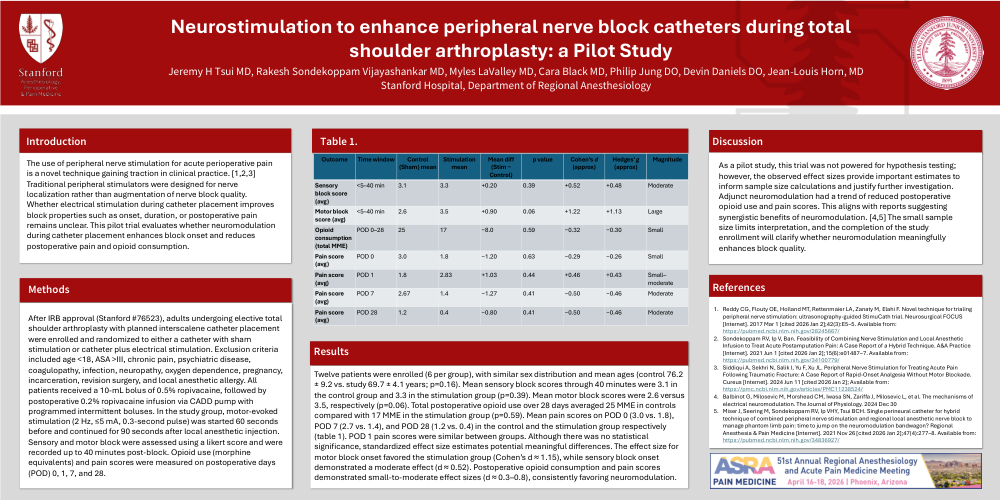
The use of peripheral nerve stimulation for acute perioperative pain is a novel technique gaining traction in clinical practice. [1,2,3] Traditional peripheral stimulators were designed for nerve localization rather than augmentation of nerve block quality. Whether electrical stimulation during catheter placement improves block properties such as onset, duration, or postoperative pain remains unclear. This pilot trial evaluates whether neuromodulation during catheter placement enhances block onset and reduces postoperative pain and opioid consumption.
Methods
After IRB approval (Stanford #76523), adults undergoing elective total shoulder arthroplasty with planned interscalene catheter placement were enrolled and randomized to either a catheter with sham stimulation or catheter plus electrical stimulation. Exclusion criteria included age <18, ASA >III, chronic pain, psychiatric disease, coagulopathy, infection, neuropathy, oxygen dependence, pregnancy, incarceration, revision surgery, and local anesthetic allergy. All patients received a 10-mL bolus of 0.5% ropivacaine, followed by postoperative 0.2% ropivacaine infusion via CADD pump with programmed intermittent boluses. In the study group, motor-evoked stimulation (2 Hz, ≤5 mA, 0.3-second pulse) was started 60 seconds before and continued for 90 seconds after local anesthetic injection. Sensory and motor block were assessed using a likert score and were recorded up to 40 minutes post-block. Opioid use (morphine equivalents) and pain scores were measured on postoperative days (POD) 0, 1, 7, and 28.
Results
Twelve patients were enrolled (6 per group), with similar sex distribution and mean ages (control 76.2 ± 9.2 vs. study 69.7 ± 4.1 years; p=0.16). Mean sensory block scores through 40 minutes were 3.1 in the control group and 3.3 in the stimulation group (p=0.39). Mean motor block scores were 2.6 versus 3.5, respectively (p=0.06). Total postoperative opioid use over 28 days averaged 25 MME in controls compared with 17 MME in the stimulation group (p=0.59). Mean pain scores on POD 0 (3.0 vs. 1.8), POD 7 (2.7 vs. 1.4), and POD 28 (1.2 vs. 0.4) in the control and the stimulation group respectively (table 1). POD 1 pain scores were similar between groups. Although there was no statistical significance, standardized effect size estimates potential meaningful differences. The effect size for motor block onset favored the stimulation group (Cohen’s d ≈ 1.15), while sensory block onset demonstrated a moderate effect (d ≈ 0.52). Postoperative opioid consumption and pain scores demonstrated small-to-moderate effect sizes (d ≈ 0.3–0.8), consistently favoring neuromodulation.
Discussion
As a pilot study, this trial was not powered for hypothesis testing; however, the observed effect sizes provide important estimates to inform sample size calculations and justify further investigation. Adjunct neuromodulation had a trend of reduced postoperative opioid use and pain scores. This aligns with reports suggesting synergistic benefits of neuromodulation. [4,5] The small sample size limits interpretation, and the completion of the study enrollment will clarify whether neuromodulation meaningfully enhances block quality.