395 posters, 1 audios, 13 topics, 29 sessions, 1,056 authors, 461 institutions
ePostersLive by SciGen Technologies S.A. All rights reserved.
51st Annual Regional Anesthesiology and Acute Pain Medicine Meeting
April 16 - 18, 2026 | Phoenix, Arizona

2316002
Utilization of Fascial Plane Blocks in Patients with Complex/Chronic Pain Undergoing Spine Surgery: An Institutional Experience
Poster Presenter
Authors
Maaz Khan, Junying Wang, William Chan, Mary Kelly, Dae Kim, Spencer Liu, Seth Waldman, Jiabin Liu, Jashvant Poeran, Faye Rim, Alexandra Sideris, Stavros Memtsoudis, Ellen Soffin
Affiliations
Hospital for Special Surgery, Pain Prevention Research Center Department of Anesthesiology, Critical Care & Pain Management, Hospital for Special Surgery, New York, NY, USA,
Part of Topic
Scientific Abstracts > Regional Anesthesia
Utilization of Fascial Plane Blocks in Patients with Complex/Chronic Pain Undergoing Spine Surgery: An Institutional Experience
Maaz S. Khan, MBBS, MD1; Junying Wang, PhD1; William Chan, MEng1; Mary Kelly, DNP1; Dae Kim, MD1; Spencer Liu, MD1; Seth Waldman, MD1; Jiabin Liu, MD, PhD, FASA1,2; Jashvant Poeran, MD, PhD1,2; Faye Rim, MD, FAAPMR1; Alexandra Sideris, PhD1,2; Stavros Memtsoudis, MD, PhD, MBA1,2; Ellen Soffin, MD1,2
1Pain Prevention Research Center Department of Anesthesiology, Critical Care & Pain Management, Hospital for Special Surgery, New York, NY, USA
2Department of Anesthesiology, Weill Cornell Medicine, New York, NY, USA
Introduction
Complex pain patients are more likely to experience poor outcomes after surgery. At Hospital for Special Surgery, the Perioperative Pain Service (POPS) manages these high-risk patients by developing personalized multimodal pain management plans1. For patients with complex pain undergoing spine surgery, strategies include regional techniques such as the erector spinae plane block (ESP)2,3. The aim of this study was to describe fascial plane block (FPB) utilization in patients with complex pain undergoing spine surgery.
Materials and Methods
After IRB approval (IRB#2021-1899), we retrospectively queried our internally validated POPS registry data records between 01/12/2022 and 11/03/2025, limited to patients who underwent a spine procedure and required an inpatient consultation with the complex/chronic pain service arm of POPS. Data extracted included patient demographics, ASA physical status, block type and procedure; these variables were compared between those with and without a block. Categorical variables were compared using χ² or Fisher’s exact tests and continuous variables using t-tests or Wilcoxon rank-sum tests, with statistical significance set at p< 0.05. This study was in accordance with STrengthening the Reporting of OBservational studies in Epidemiology guidelines4.
Results/Case Report
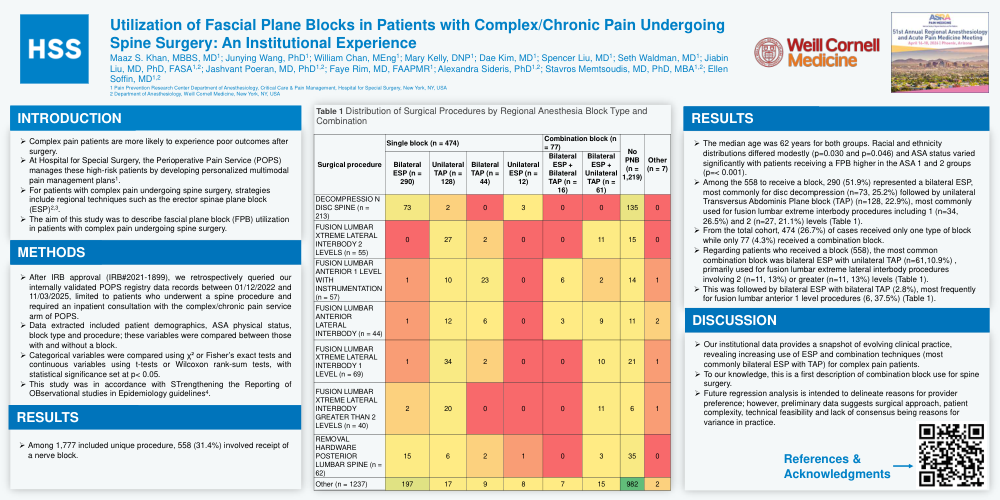
Among 1,777 included unique procedure, 558 (31.4%) involved receipt of a nerve block. The median age was 62 years for both groups. Racial and ethnicity distributions differed modestly (p=0.030 and p=0.046) and ASA status varied significantly with patients receiving a FPB higher in the ASA 1 and 2 groups (p=< 0.001).
Among the 558 to receive a block, 290 (51.9%) represented a bilateral ESP, most commonly for disc decompression (n=73, 25.2%) followed by unilateral Transversus Abdominis Plane block (TAP) (n=128, 22.9%), most commonly used for fusion lumbar extreme interbody procedures including 1 (n=34, 26.5%) and 2 (n=27, 21.1%) levels (Table 1).From the total cohort, 474 (26.7%) of cases received only one type of block while only 77 (4.3%) received a combination block. Regarding patients who received a block (558), the most common combination block was bilateral ESP with unilateral TAP (n=61,10.9%) , primarily used for fusion lumbar extreme lateral interbody procedures involving 2 (n=11, 13%) or greater (n=11, 13%) levels (Table 1). This was followed by bilateral ESP with bilateral TAP (2.8%), most frequently for fusion lumbar anterior 1 level procedures (6, 37.5%) (Table 1).
Discussion
Our institutional data provides a snapshot of evolving clinical practice, revealing increasing use of ESP and combination techniques (most commonly bilateral ESP with TAP) for complex pain patients. To our knowledge, this is a first description of combination block use for spine surgery. Future regression analysis is intended to delineate reasons for provider preference; however, preliminary data suggests surgical approach, patient complexity, technical feasibility and lack of consensus being reasons for variance in practice.
References
1. Rim F, Liu SS, Kelly M, Kim D, Sideris A, Langford DJ. Preoperative pain screening and optimisation by a perioperative pain service to support complex surgical patients: no patient left behind. British Journal of Anaesthesia. 2024;132(2):437–439.
2. Amoroso K, Beckman JA, Zhu J, et al. Impact of Erector Spinae Plane Blocks on Pain Management and Postoperative Outcomes in Patients with Chronic Pain Undergoing Spine Fusion Surgery: A Retrospective Cohort Study. Journal of Pain Research. 2024:4023–4031.
3. Garg B, Ahuja K, Sharan AD. Regional Anesthesia for Spine Surgery. JAAOS - Journal of the American Academy of Orthopaedic Surgeons. 2022;30(17):809–819. doi:10.5435/jaaos-d-22-00101
4. Von Elm E, Altman DG, Egger M, Pocock SJ, Gøtzsche PC, Vandenbroucke JP. The Strengthening the Reporting of Observational Studies in Epidemiology (STROBE) statement: guidelines for reporting observational studies. The lancet. 2007;370(9596):1453–1457.