395 posters, 1 audios, 13 topics, 29 sessions, 1,056 authors, 461 institutions
ePostersLive by SciGen Technologies S.A. All rights reserved.
51st Annual Regional Anesthesiology and Acute Pain Medicine Meeting
April 16 - 18, 2026 | Phoenix, Arizona

2315942
Liposomal Bupivacaine vs Long-acting local anesthetics for Adductor Canal Block After Total Knee Arthroplasty: Meta-analysis
Poster Presenter
Part of Topic
Scientific Abstracts > Regional Anesthesia
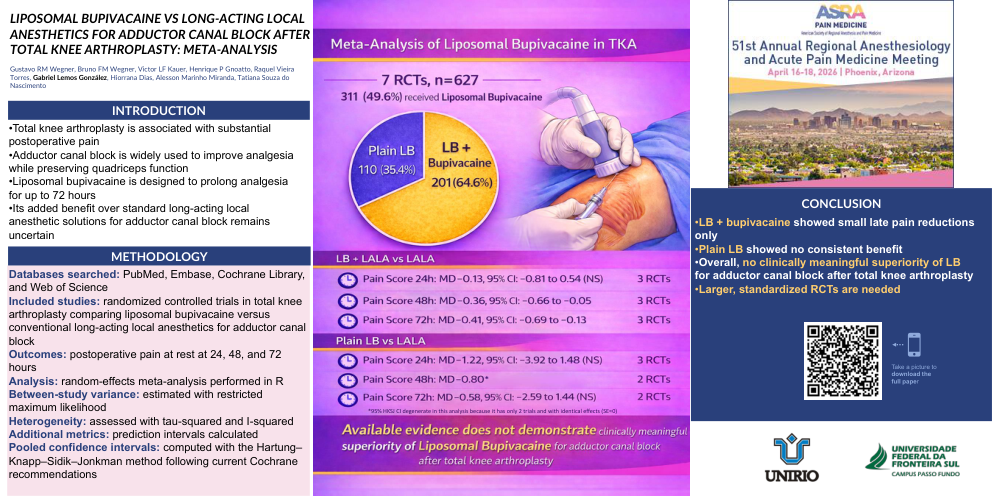
INTRODUCTION: Total knee arthroplasty is associated with substantial postoperative pain, and adductor canal block (ACB) is widely used to improve analgesia while preserving quadriceps function. Liposomal bupivacaine is a bupivacaine formulation intended to prolong analgesia for up to 72 hours, but its incremental benefit over standard long-acting local anesthetic ACB solutions remains uncertain. We performed a meta-analysis to compare liposomal bupivacaine versus conventional long-acting local anesthetics for ACB in total knee arthroplasty.
MATERIAL AND METHODS: We searched PubMed, Embase, the Cochrane Library, and Web of Science for randomized controlled trials comparing liposomal bupivacaine with conventional long-acting local anesthetics for adductor canal block in patients undergoing total knee arthroplasty. Outcomes were postoperative pain scores at rest at 24, 48, and 72 hours. Meta-analyses were performed in R using random-effects models, with between-study variance (tau²) estimated by restricted maximum likelihood (REML). Statistical heterogeneity was quantified using tau² and I². We calculated prediction intervals, and confidence intervals for pooled effects were computed using the Hartung–Knapp–Sidik–Jonkman method in accordance with the new recommendations of the Cochrane handbook.
RESULTS: We included 7 RCTs (n=627), with 311 (49.6%) patients allocated to liposomal bupivacaine. Among LB recipients, 110 (35.36%) received plain LB and 201 (64.6%) received LB admixed with bupivacaine. LB+LALA vs LALA showed no difference in pain scores at rest at 24 h (3 RCTs; n=332; MD −0.13; 95% CI, −0.81 to 0.54; p=0.4821; I²=0%), but small reductions at 48 h (3 RCTs; n=332; MD −0.36; 95% CI, −0.66 to −0.05; p=0.0371; I²=0%) and 72 h (3 RCTs; n=332; MD −0.41; 95% CI, −0.69 to −0.13; p=0.0243; I²=0%). Plain LB vs LALA showed no difference at 24 h (3 RCTs; n=222; MD −1.22; 95% CI, −3.92 to 1.48; p=0.1915; I²=87%) or 72 h (2 RCTs; n=103; MD −0.58; 95% CI, −2.59 to 1.44; p=0.1705; I²=0%); at 48 h, the pooled estimate was MD −0.80 (2 RCTs; n=103; 95% CI, −0.80 to −0.80; p<0.0001; I²=0%), reflecting a degenerate Hartung–Knapp variance with identical study effects.
DISCUSSION: In this meta-analysis, LB admixed with bupivacaine (LB+LALA) was associated with small reductions in pain at 48 and 72 hours, but not at 24 hours. Plain LB showed no consistent advantage over standard long-acting local anesthetics. Overall, the available evidence does not demonstrate clinically meaningful superiority of LB for adductor canal block after total knee arthroplasty, and further well-powered, standardized RCTs are needed.