395 posters, 1 audios, 13 topics, 29 sessions, 1,056 authors, 461 institutions
ePostersLive by SciGen Technologies S.A. All rights reserved.
51st Annual Regional Anesthesiology and Acute Pain Medicine Meeting
April 16 - 18, 2026 | Phoenix, Arizona

2294859
Peripheral Nerve Blocks as Primary Anesthetic for Total Knee Arthroplasty in a High-Risk Patient
Poster Presenter
Part of Topic
Medically Challenging Cases
Peripheral Nerve Block as Primary Anesthetic for Primary Total Knee Arthroplasty in a High Risk Patient
Use of multiple PNBs yields adequate surgical block for total knee replacement.
Introduction:
TKA is commonly performed under general anesthesia (GA) or
neuraxial anesthesia (NA). Combined PNB may offer access to
TKA in patients at high risk for GA with contraindications to
NA.
Material/Methods:
- Case report
- Plain bupivacaine 0.5% used in all described blocks.
Results/Case Study:
- Demographic: 76-year-old male with history of heart failure
with ejection fraction of 20%, biventricular AICD, symptomatic
hypotension requiring steroids, coronary artery disease with
previous myocardial infarction on ticagrelor, and chronic kidney
disease
- Procedure: TKA under NA
- Contraindication: taken ticagrelor 1 day prior
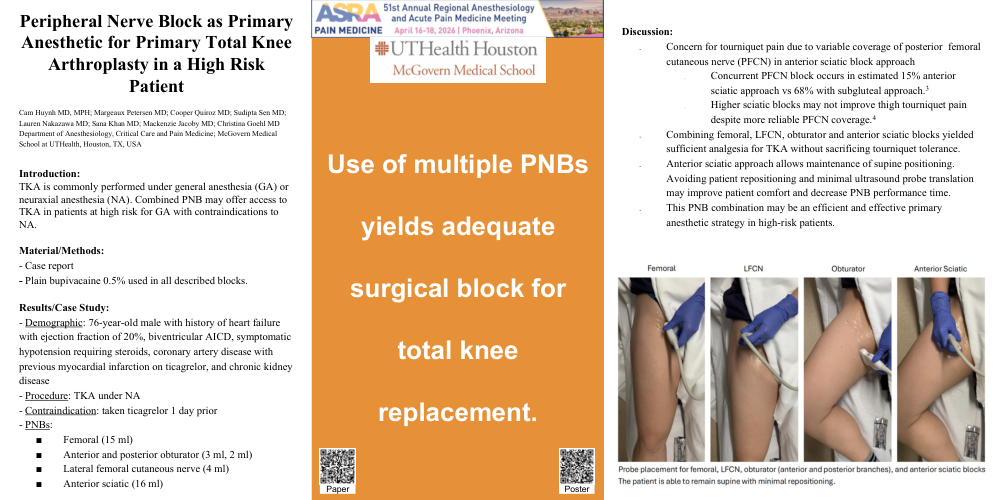
- PNBs:
■ Femoral (15 ml)
■ Anterior and posterior obturator (3 ml, 2 ml)
■ Lateral femoral cutaneous nerve (4 ml)
■ Anterior sciatic (16 ml)
Discussion:
● Concern for tourniquet pain due to variable coverage of posterior femoral
cutaneous nerve (PFCN) in anterior sciatic block approach
○ Concurrent PFCN block occurs in estimated 15% anterior
sciatic approach vs 68% with subgluteal approach.3
○ Higher sciatic blocks may not improve thigh tourniquet pain
despite more reliable PFCN coverage.4
● Combining femoral, LFCN, obturator and anterior sciatic blocks yielded
sufficient analgesia for TKA without sacrificing tourniquet tolerance.
● Anterior sciatic approach allows maintenance of supine positioning.
Avoiding patient repositioning and minimal ultrasound probe translation
may improve patient comfort and decrease PNB performance time.
● This PNB combination may be an efficient and effective primary
anesthetic strategy in high-risk patients.