206 posters, 13 topics, 5 sessions, 713 authors, 294 institutions
ePostersLive by SciGen Technologies S.A. All rights reserved.
AAPS 104th Annual Meeting
May 2-5, 2026 | Lihue, HI

PC1
Patient Reported Outcome Measures Following Post-bariatric Body Contouring: A Systematic Review And Meta-analysis
Poster Presenter
Authors
Jonathan Mokhtar, Fatemeh Akbarpoor, Marwa Hadi, Guilherme Machado, Karen Blanco, Lorenzo DiMartino, Alexandre Lellouch, Raffi Gurunian, Lucas Kreutz-Rodrigues, Sarah Bishop
Affiliations
Mohammed Bin Rashid University of Medicine and Health Sciences, Division of Plastic and Reconstructive Surgery, Cedars Sinai Hospital, Los Angeles, USA; Université Paris Cité, Dubai Medical University, College of Pharmacy, Dubai, United Arab Emirates, Hospital Santa Marcelina, São Paulo, Brazil,
Part of Topic
Aesthetic Breast/Body Contouring
Background
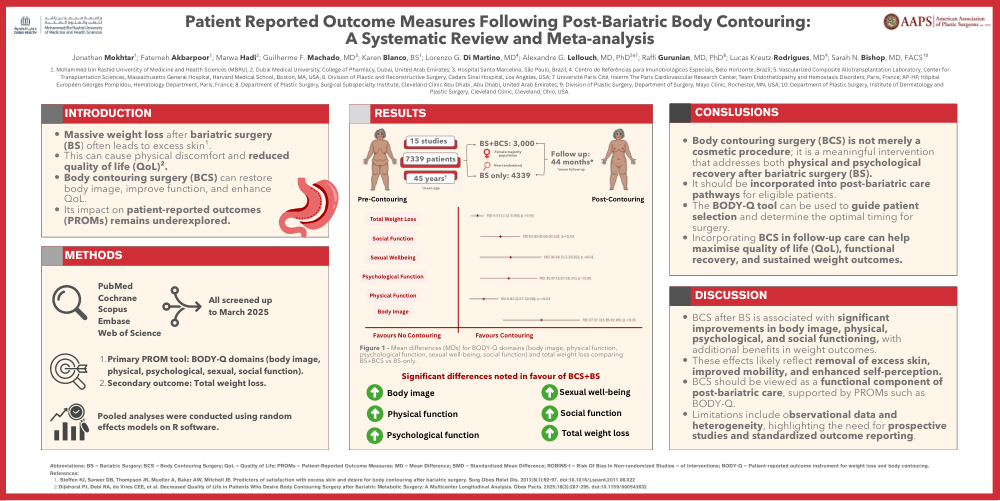
Massive weight loss after bariatric surgery (BS) often results in excess skin, leading to physical discomfort and impaired quality of life (QoL). Body contouring surgery (BCS) addresses these issues by restoring body image, improving function, and enhancing overall QoL, yet its added value on patient-reported outcome measures (PROMs) remains underexplored.
Methods
A systematic search of PubMed, Scopus, Embase, Web of Science, and Cochrane databases was conducted from inception to March 2025. Studies comparing PROMs between patients undergoing BS alone and those undergoing BS+BCS were included. Retrieved studies were assessed using the Risk Of Bias In Non-randomized Studies – of Interventions (ROBINS-I) tool. Outcomes were pooled using random effects models.
Results
Fifteen non-randomized studies involving 7339 patients were included (BS-only: 4339 [59.1%]; BS+BCS: 3,000 [40.9%]). BS+BCS patients had significantly greater total weight loss (MD = 4.40 kg, 95% CI [1.69, 7.10 ], p <0.01). BODY-Q improvements favored the BS+BCS group in body image, physical, psychological, sexual, and social function (MD = 16.07, 95% CI [12.14, 20.0], p <0.01). Among BS-only patients, those desiring BCS reported lower body satisfaction (MD = -0.40, 95% CI [-0.70, -0.10], p < 0.01) and lower appraisal of excess skin scores (SMD = –1.09; 95% CI [–1.83, –0.36]; p = 0.02) than those without desire for BCS.
Conclusion
BCS following BS yields substantial improvements in the overall quality of life. These findings highlight its importance as a fundamental element of comprehensive post-bariatric care that significantly enhances long-term patient satisfaction and drives durable multidimensional recovery.