206 posters, 13 topics, 5 sessions, 713 authors, 294 institutions
ePostersLive by SciGen Technologies S.A. All rights reserved.
AAPS 104th Annual Meeting
May 2-5, 2026 | Lihue, HI

PC9
The Debate Ends: Immediate And Delayed Free Flap Breast Reconstruction Have Comparable Outcomes. A National 10-year Cohort Study Of Over 20,000 Autologous Breast Reconstruction Procedures
Poster Presenter
Authors
Georgios Karamitros, Catic Armin, Franklin Gergoudis, Carrie Kubiak, Wesley Thayer, Sevastiano Barbieri, Luisa Jorm, William Lineaweaver, Galen Perdikis, Gregory Lamaris
Affiliations
Vanderbilt University, Center for Big Data Research in Health, University of New South Wales, Sydney, Australia, University of Maryland Medical Center
Part of Topic
Breast Reconstruction
Background:
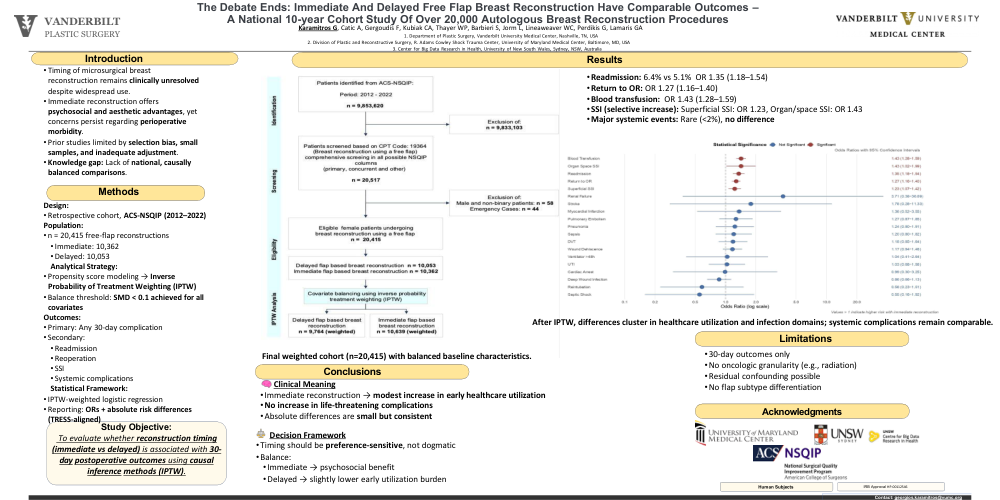
The optimal timing of microsurgical breast reconstruction remains debated. Immediate reconstruction offers psychosocial benefits but may increase perioperative risk, while delayed reconstruction allows for patient optimization. Prior studies are limited by selection bias and small cohorts.
Methods:
We performed a retrospective analysis of the ACS-NSQIP database (2012–2022), including 20,415 patients undergoing free-flap breast reconstruction. Inverse probability of treatment weighting (IPTW) was used to balance covariates. Primary and secondary 30-day outcomes were assessed using weighted logistic regression.
Results:
After IPTW, immediate reconstruction was associated with higher readmission (6.4% vs 5.1%; OR 1.35), reoperation (OR 1.27), and transfusion (OR 1.43), as well as increased surgical site infections. Major systemic complications were rare and did not differ between groups.
Conclusions:
Immediate and delayed reconstruction demonstrate comparable overall safety profiles. Immediate reconstruction is associated with modest increases in early healthcare utilization but no increase in life-threatening complications. These findings support individualized, preference-sensitive decision-making.