206 posters, 13 topics, 5 sessions, 713 authors, 294 institutions
ePostersLive by SciGen Technologies S.A. All rights reserved.
AAPS 104th Annual Meeting
May 2-5, 2026 | Lihue, HI

D68
Thromboembolic And Hemorrhagic Risks Following Mastectomy With Versus Without Direct-to-implant Reconstruction: A Propensity Score Matched Analysis
Poster Presenter
Authors
Jonathan Mokhtar, John Ha, Jewel Haddad, Curtis Cetrulo, David Smadja, Alexandre Lellouch
Affiliations
Mohammed Bin Rashid University of Medicine and Health Sciences, School of Medicine, Case Western Reserve University, Cleveland, OH, USA, Division of Plastic and Reconstructive Surgery, Cedars Sinai Hospital, Los Angeles, USA, Université Paris Cité, Inserm The Paris Cardiovascular Research Center, Team Endotheliopathy and Hemostasis Disorders, Paris, France, Division of Plastic and Reconstructive Surgery, Cedars Sinai Hospital, Los Angeles, USA; Université Paris Cité
Part of Topic
Breast Reconstruction
Background
Immediate direct-to-implant (DTI) breast reconstruction following mastectomy (MT) provides aesthetic and logistical advantages, including single-stage restoration and avoidance of tissue expansion. However, concerns persist that increased operative duration and procedural complexity may elevate thromboembolic and hemorrhagic risk. This study compared 90-day postoperative complication rates between MT vs. MT+DTI reconstruction.
Methods
A multicenter cohort study was conducted using the TriNetX Research Network, a global federated database of electronic health records. Adult female patients with breast cancer undergoing MT with or without immediate DTI between 2010 and 2025 were included; autologous and staged reconstructions were excluded. Propensity score matching (1:1) balanced demographics, BMI, comorbidities, oncologic history, and preoperative medications. Outcomes included hematoma, acute deep vein thrombosis (DVT), and pulmonary embolism (PE).
Results
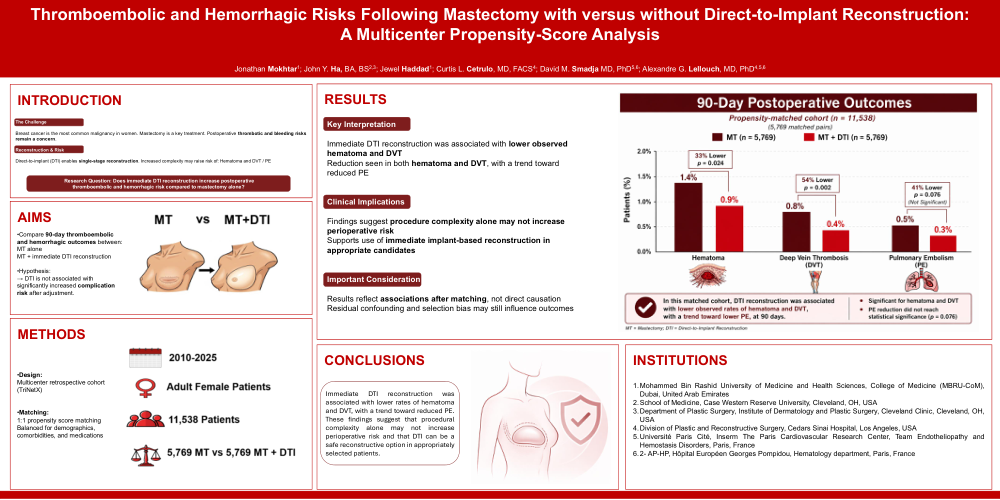
After matching, 11,538 patients (5,769 pairs) were analyzed. MT+DTI was associated with lower hematoma rates (0.9% vs. 1.4%; RR 0.675; 95% CI [0.48, 0.95]; p = 0.02) and fewer DVT events (0.4% vs. 0.8%; RR 0.46; 95% CI [0.28, 0.76]; p = 0.002). PE occurred in 0.3% of patients vs. 0.5% (RR 0.59; 95% CI [0.32, 1.1]; p = 0.08).
Conclusions
Immediate direct-to-implant reconstruction following mastectomy was associated with lower short-term rates of hematoma and DVT, accompanied by a clinically meaningful trend toward reduced PE. These findings challenge the assumption that procedural complexity intrinsically confers higher perioperative morbidity. Given the limitations of coding-based observational data and potential residual confounding, prospective multicenter studies incorporating granular perioperative variables are required to confirm these associations and refine risk-stratified decision-making in reconstructive care.