206 posters, 13 topics, 5 sessions, 713 authors, 294 institutions
ePostersLive by SciGen Technologies S.A. All rights reserved.
AAPS 104th Annual Meeting
May 2-5, 2026 | Lihue, HI

D25
Hyaluronic Acid Fillers For Chin And Jawline Augmentation: A Bayesian Network Meta-Analysis Of Randomized Controlled Trials
Poster Presenter
Authors
Guilherme Franceschini Machado, Lucas Monteiro Delgado, Jonathan Mokhtar, Lucas Kreutz-Rodrigues
Affiliations
Hospital Santa Marcelina, Brazil, Hospital Santa Marcelina, São Paulo, Brazil, Universidade Federal de Minas Gerais, Belo Horizonte, Brazil, Mohammed Bin Rashid University of Medicine and Health Sciences, College of Medicine (MBRU-CoM), Dubai, United Arab Emirates, Division of Plastic Surgery, Mayo Clinic, Rochester, MN, United States of America
Part of Topic
Aesthetic Face
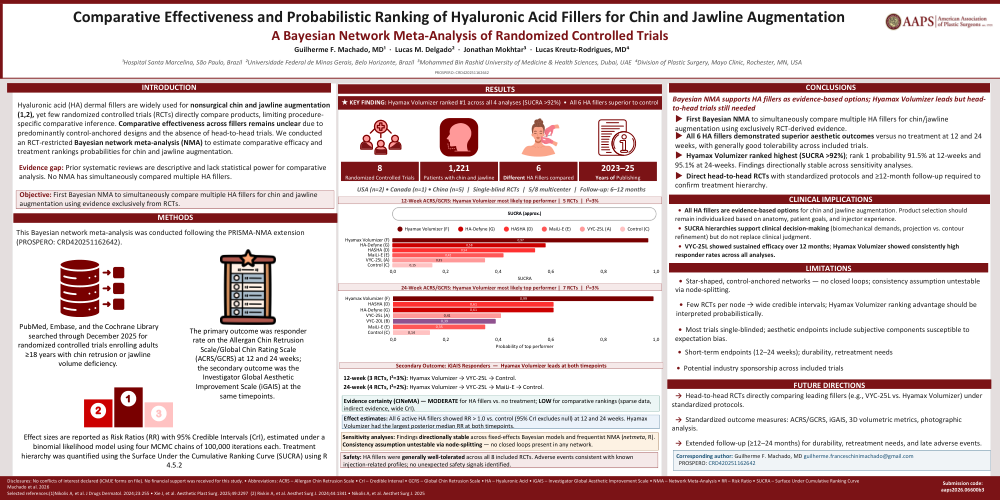
Title: Comparative Effectiveness and Probabilistic Ranking of Hyaluronic Acid Fillers for Chin and Jawline Augmentation: A Bayesian Network Meta-Analysis of Randomized Controlled Trials
Authors: Guilherme F. Machado, MD (Hospital Santa Marcelina, São Paulo, Brazil); Lucas M. Delgado (Universidade Federal de Minas Gerais, Belo Horizonte, Brazil); Jonathan Mokhtar (Mohammed Bin Rashid University of Medicine & Health Sciences, Dubai, UAE); Lucas Kreutz-Rodrigues, MD (Division of Plastic Surgery, Mayo Clinic, Rochester, MN, USA) PROSPERO: CRD420251162642
Background: Hyaluronic acid (HA) fillers are the primary non-surgical approach for chin retrusion and lower-face volume deficiency, yet no prior study has simultaneously compared multiple FDA-cleared HA fillers using a network meta-analytic framework. Choosing among agents has relied on single-trial evidence and clinical experience rather than integrated comparative data.
Objective: To compare the effectiveness and probabilistic ranking of six HA fillers versus control for chin and jawline augmentation using Bayesian network meta-analysis. Methods: Bayesian network meta-analysis following the PRISMA-NMA extension (PROSPERO: CRD420251162642). Databases searched: PubMed, Embase, and Cochrane Library through December 2025. Population: adults ≥18 years with chin retrusion or lower-face volume deficiency. Interventions: VYC-25L (A), VYC-20L (B), HASHA (D), MaiLi-E (E), Hyamax Volumizer (F), HA-Defyne (G) versus untreated control (C). Primary outcome: responder rate on the Allergan Chin Retrusion Scale/Global Chin Retrusion Scale (ACRS/GCRS) at 12 and 24 weeks. Secondary outcome: Investigator Global Aesthetic Improvement Scale (iGAIS) at 12 and 24 weeks. Effect measure: Risk Ratios (RR) with 95% Credible Intervals (CrI) under a binomial likelihood model; four MCMC chains of 100,000 iterations (PSRF ≤1.2). Treatment hierarchy: Surface Under the Cumulative Ranking Curve (SUCRA).
Results: 8 RCTs; 1,221 patients; 6 HA fillers; published 2023–2025. Geographic distribution: USA (n=2), Canada (n=1), China (n=5). Heterogeneity was low across all analyses (I²=3%). 12-Week ACRS/GCRS (5 RCTs): Posterior median treatment effects favored all active fillers versus control. Hyamax Volumizer ranked most likely best (P[Rank 1]=91.5%); HA-Defyne P(Rank 2)=39.0%; HASHA P(Rank 2)=29.4%; control ranked last (P[Rank 6]=47.9%). 24-Week ACRS/GCRS (7 RCTs): All 6 HA fillers favored over control. Hyamax Volumizer dominated rankings (P[Rank 1]=95.1%; SUCRA >92%); HASHA P(Rank 2)=35.2%; HA-Defyne P(Rank 2)=34.6%; control ranked last (P[Rank 7]=44.9%). 12-Week iGAIS (3 RCTs, 3-node network): Both VYC-25L and Hyamax Volumizer favored over control; Hyamax Volumizer ranked first. 24-Week iGAIS (4 RCTs): VYC-25L, MaiLi-E, and Hyamax Volumizer all favored over control; Hyamax Volumizer ranked highest (SUCRA >92%), followed by VYC-25L and MaiLi-E. Evidence certainty (CINeMA): Moderate for HA fillers versus control; Low for comparative rankings between individual fillers.
Conclusions: All six evaluated HA fillers demonstrated superior aesthetic outcomes compared with no treatment for chin and jawline augmentation at 12 and 24 weeks. Hyamax Volumizer ranked first across all four analyses (SUCRA >92%), with findings directionally stable across sensitivity analyses. Evidence certainty for comparative rankings is low, driven by sparse data per node, indirect comparisons only, and star-shaped network geometry. Direct head-to-head RCTs are needed to confirm treatment hierarchy.
Clinical Implications: All HA fillers in this class are evidence-based options for chin and jawline augmentation. Product selection should remain individualized based on patient anatomy, biomechanical demands, and injector experience. SUCRA hierarchies support clinical decision-making but do not replace individualized judgment. Direct comparative trials are required before definitive treatment recommendations can be made.
Disclosures: No conflicts of interest declared (ICMJE forms on file). No financial support was received for this study.
Corresponding author: Guilherme F. Machado, MD — guilherme.franceschinimachado@gmail.com Abbreviations: ACRS – Allergan Chin Retrusion Scale; CrI – Credible Interval; GCRS – Global Chin Retrusion Scale; HA – Hyaluronic Acid; iGAIS – Investigator Global Aesthetic Improvement Scale; NMA – Network Meta-Analysis; RR – Risk Ratio; SUCRA – Surface Under the Cumulative Ranking Curve